Employer profile · engineering and manufacturing
Reckitt
The consumer health and hygiene group behind Dettol, Nurofen and Gaviscon began life in a Hull starch works in 1840, and its Dansom Lane site remains one of the city's largest science and manufacturing employers.
Updated 3 September 2026
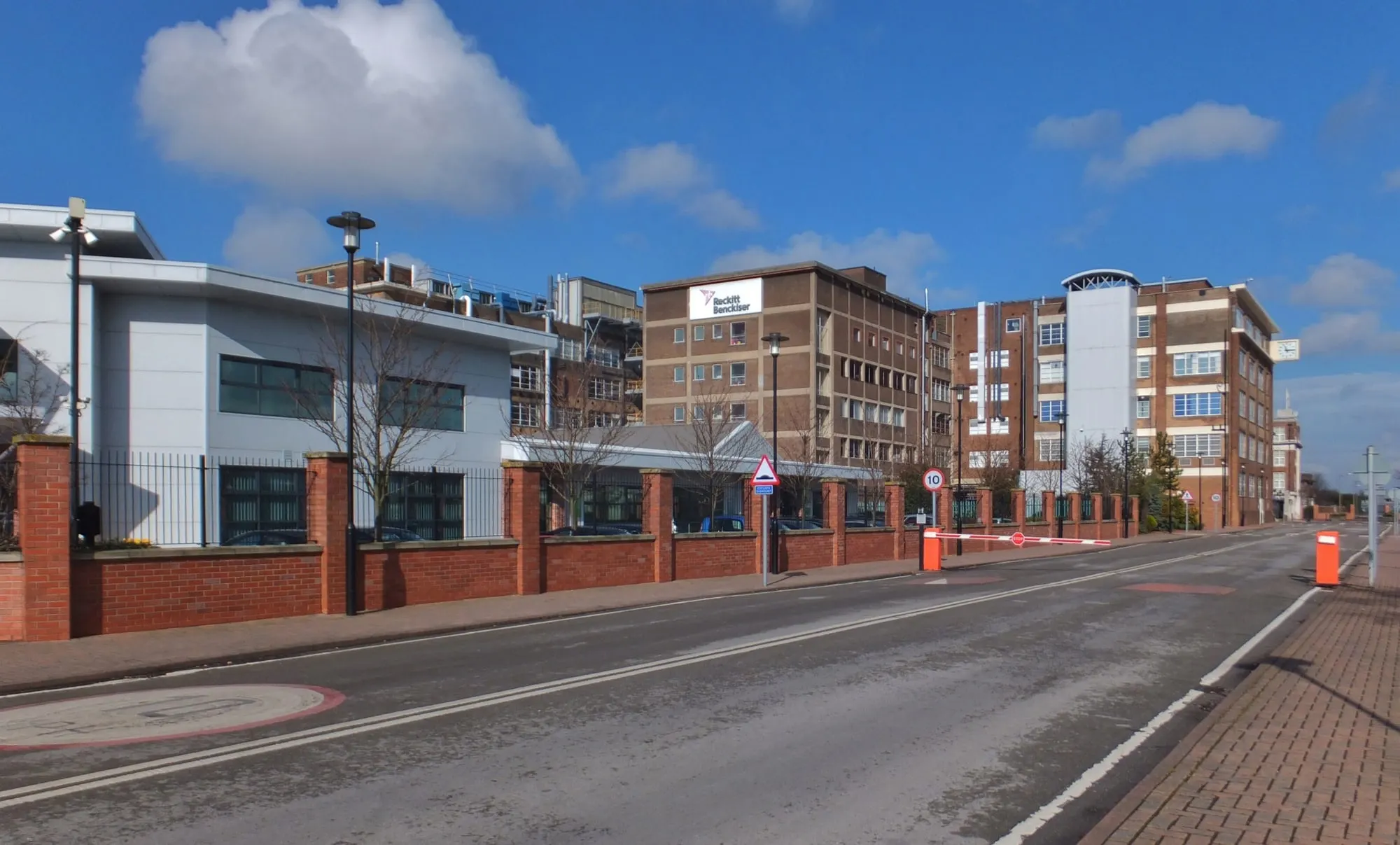

Reckitt is one of the world’s largest consumer health and hygiene companies, and Hull is where it started. Isaac Reckitt leased a starch works on Dansom Lane in east Hull in 1840, and the company’s heritage archive is still kept on the same site. For a city that has watched plenty of manufacturers come and go, Reckitt is unusual: a global business whose original site is still a working factory and research centre, and one of the more significant employers in our engineering and manufacturing sector guide.
What Reckitt does
Reckitt’s business is built on brands most households will recognise. Its health range includes Nurofen, Strepsils, Gaviscon, Lemsip and Mucinex; its hygiene brands include Dettol, Harpic, Finish and Lysol. In 2024 the group announced a reorganisation into three distinct businesses. Its global head office is in Slough, but Hull has kept a role that goes well beyond a heritage plaque.
The Hull site: manufacturing and research on one campus
Dansom Lane does two things. It is a manufacturing plant producing finished consumer health products, and it is one of Reckitt’s six major research and development facilities worldwide. In December 2019 the company opened a £105m Science and Innovation Centre there, described at the time as its largest ever single investment and the first part of a £200m commitment to Hull, with a further £95m earmarked for upgrading the manufacturing side.
The scale is substantial. At the 2019 opening Reckitt said around 1,400 people worked in Hull, with the new centre expected to add around 200 jobs. The company has put the number of scientists on site at roughly 600 and its output at around 300 million consumer units a year, with Nurofen, Strepsils, Gaviscon and Dettol among the products made there. The centre acts as a global technical innovation hub for pain relief and sore throat products, with laboratories, a large stability testing suite, a sensory suite and a pilot plant for trialling new products at a fraction of factory scale.
Those figures come from the company’s own announcements around 2019, and Reckitt does not routinely publish a current Hull headcount, so treat 1,400 as an indication of scale rather than a live number.
Typical roles
Because the site combines a factory with an R&D centre, the mix of work is broader than at most manufacturing employers in the region:
- Laboratory and R&D scientists — formulation, analytical chemistry, microbiology, stability testing and product development, usually needing a relevant degree or higher
- Regulatory affairs and quality assurance — a large function at any site making licensed medicines
- Production and packaging operatives — shift-based roles on manufacturing and packing lines
- Engineering and maintenance — mechanical, electrical and automation engineers keeping production equipment running
- Supply chain, planning, HR, finance, procurement and site support
Pay depends heavily on which side of the site you are on. As a broad indicative guide only, UK manufacturing operative roles typically start around £24,000–£28,000 depending on shift pattern, while graduate scientists and engineers in consumer health often start in the £28,000–£35,000 range, with experienced specialists earning considerably more. These are general sector ranges, not figures tied to any Reckitt vacancy.
Graduate schemes and early careers
Reckitt runs structured early careers programmes, and its careers portal lists graduate and intern opportunities as a distinct category. One example relevant to the Humber is the Supply Future Leadership Scheme, a two-year graduate programme that has been advertised with rotations across Hull and Nottingham, covering planning, quality, packaging, manufacturing, engineering, procurement and logistics.
Public detail on apprenticeship intakes at the Hull site is thinner than for the graduate route. Our Hull apprenticeships guide and the piece on getting into engineering without a degree cover the wider options, and it is worth asking Reckitt directly about current plans.
Working for Reckitt in Hull
Reckitt’s long history in the city gives it a local reputation few employers can match, and the 2019 investment signalled continued commitment rather than a gradual wind-down. Work in a regulated consumer health environment tends to mean structured processes, formal training and clear quality standards.
This profile draws on Reckitt’s announcements and public reporting, not on employee accounts, so we cannot verify day-to-day conditions in particular departments. Use the Reckitt careers portal for current vacancies, and see our Hull jobs and careers guide for how the site fits into the wider city labour market.
Independent editorial profile written by Humber Careers; not sponsored by or supplied by Reckitt. Confirm current details on the employer's own site before applying.
Sources
- –Reckitt — Our history
- –Reckitt — RB confirms £200m UK investment commitment including new Science & Innovation Centre (2019)
- –Reckitt — RB's new world of inspiring science (2019)
- –Hull City Council news — Take a first look at RB's £105m Science and Innovation Centre (December 2019)
- –Reckitt careers — Supply Future Leadership Scheme, Hull (job listing)